
Data Processing and Standardization
Parcel data is collected from various authoritative sources, primarily county and municipal tax assessor offices, planning departments, and GIS departments. Dat…
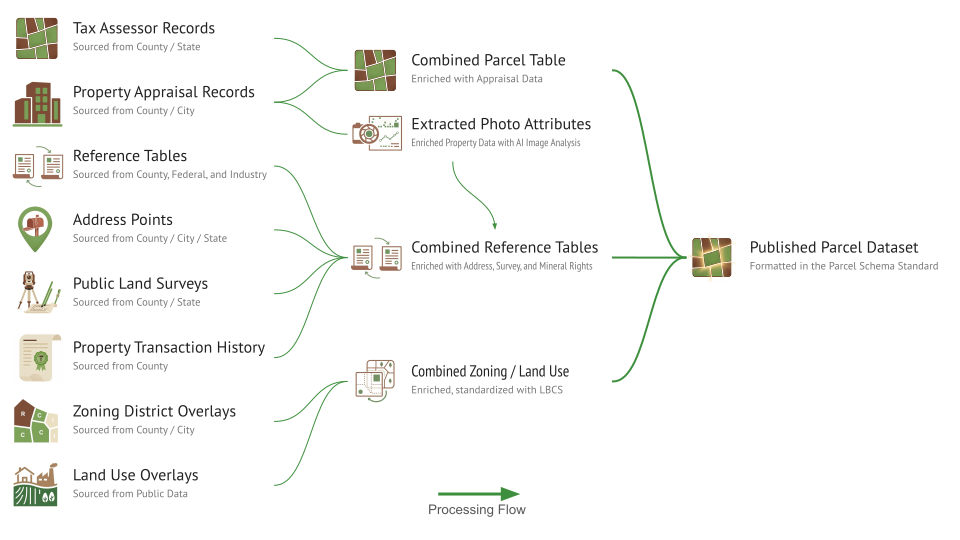
3.1. Data Ingestion and Processing
Parcel data is collected from various authoritative sources, primarily county and municipal tax assessor offices, planning departments, and GIS departments. Data formats and source accuracy and update frequency vary widely.
3.2. Data Harmonization and Standardization
As of December 2025, the land record database maintains a catalog of data sources for over 3,200 US counties and all 50 states plus the District of Columbia and Puerto Rico. Each of these data sources are merged with others that represent the same county, and each of the combined table’s fields is mapped and typecasted onto the target schema described in Section 2.
3.3. Quality Control and Validation
Multiple quality control checks are performed:
- Geometric Validation: Checks for topology errors (e.g., self-intersections, sliver polygons, gaps between adjacent parcels) and invalid geometries.
- Attribute Validation: Checks for missing values in critical fields, data type conformity, and adherence to domain constraints.
- Spatial Accuracy Assessment: Visual inspection and comparisons against high-resolution imagery and known reference points to identify significant spatial discrepancies. (This is where we use our human eyeballs and point them toward QGIS to see if anything looks “off”).
- Temporal Consistency: Monitoring changes in parcel data over time to ensure updates are captured accurately.
- Statistical Congruence: Many corrections are made based on statistical analyses of the datasets and the patterns of individual attributes and attribute categories.